Canadian Citizenship Through Naturalization
Canada offers citizenship primarily through birth in Canada or through naturalization. Permanent residents who meet the eligibility requirements may apply to become Canadian citizens through the naturalization process.
Generally, to qualify for Canadian citizenship, a permanent resident must have been physically present in Canada for at least 1,095 days during the five years immediately before applying. Applicants must also meet applicable tax filing obligations, language requirements, and citizenship test requirements.
The Canadian citizenship application process can involve several eligibility criteria and documentation requirements. Working with an experienced immigration lawyer can help ensure that your application is properly prepared and that potential issues are identified before submission.
Why You Need an Experienced Immigration Lawyer
Applying for Canadian citizenship is an important step toward becoming a Canadian citizen. Although many applications are straightforward, individual circumstances can sometimes make the process more complicated.
An experienced immigration lawyer can assist you with:
Reviewing your eligibility for Canadian citizenship
Calculating your physical presence in Canada
Assessing your permanent resident status and travel history
Reviewing your tax filing requirements
Explaining language proficiency requirements
Helping you prepare and organize supporting documents
Assisting with citizenship applications and related issues
Identifying potential concerns that may affect your eligibility
Providing guidance if you have a criminal or immigration history
Professional legal guidance can help you better understand the citizenship process and ensure that your application is complete and accurately prepared.
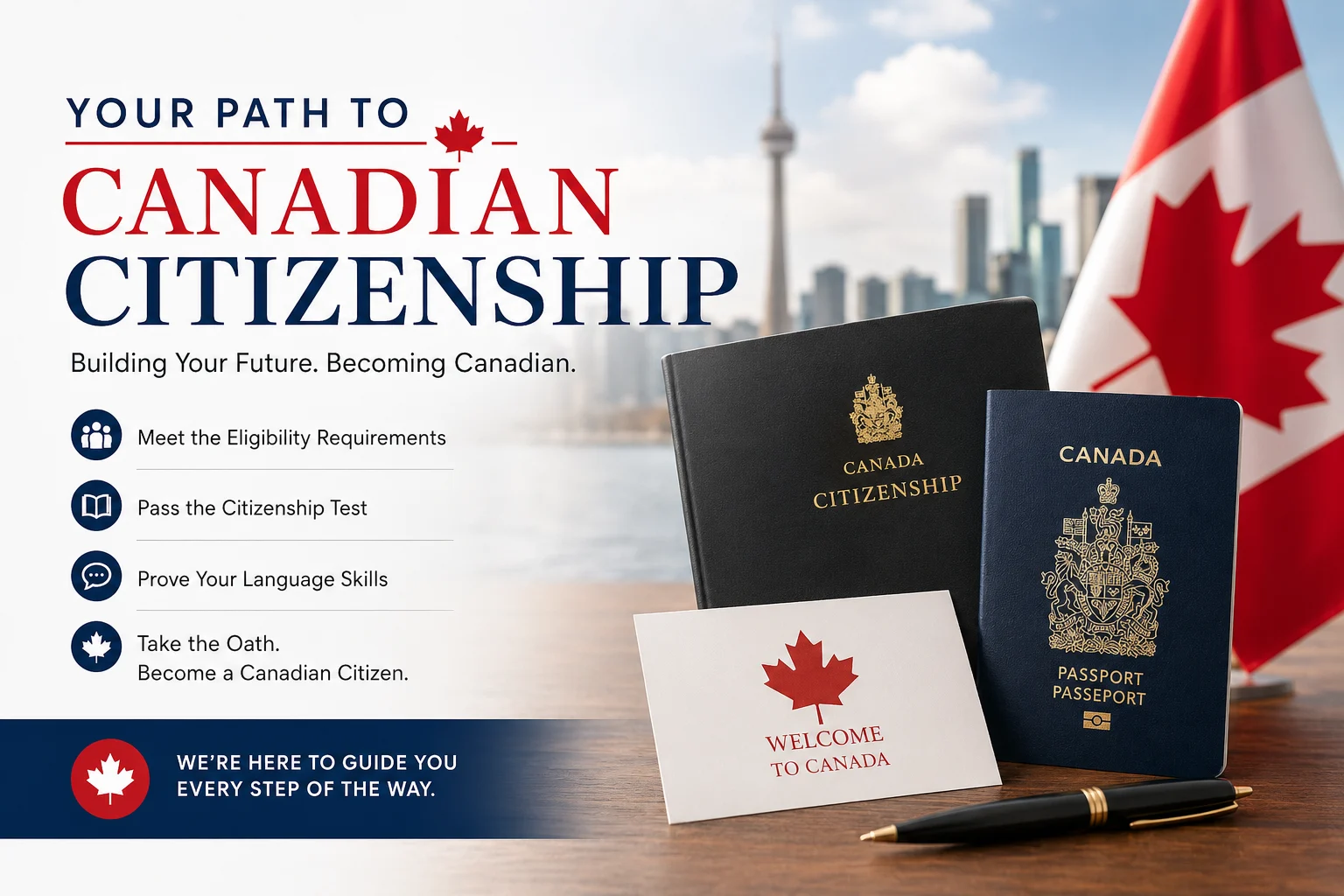 Canadian Citizenship Requirements
To apply for Canadian citizenship through naturalization, applicants generally need to meet the following requirements:
1. Be a Permanent Resident
You must have valid permanent resident status in Canada. Certain situations, such as being under a removal order, may affect your eligibility to apply.
2. Meet the Physical Presence Requirement
You must have been physically present in Canada for at least 1,095 days during the five years immediately before the date you apply.
Time spent in Canada as a temporary resident or protected person may, in certain circumstances, count toward the physical presence requirement at a reduced rate, subject to applicable Canadian citizenship rules.
Because travel outside Canada can affect your eligibility, it is important to accurately calculate your physical presence before submitting your application.
3. Meet Tax Filing Requirements
Depending on your circumstances, you may be required to have filed income tax returns in Canada for at least three years during the five-year period immediately before applying.
Your tax obligations may apply even if you did not owe any income tax for a particular year. It is important to review your individual tax history to determine whether you meet this requirement.
4. Meet the Language Requirement
Canada has two official languages: English and French.
Applicants between the ages of 18 and 54 must demonstrate adequate knowledge of English or French. The language requirement focuses on the applicant’s ability to communicate effectively in everyday situations.
Applicants must generally demonstrate that they can:
Participate in short, everyday conversations
Understand simple instructions and questions
Use basic grammar and common sentence structures
Use vocabulary appropriate for routine communication
Communicate effectively in English or French in everyday situations
The citizenship language requirement applies to speaking and listening abilities. Written language proficiency is not required for this specific citizenship language requirement.
5. Pass the Canadian Citizenship Test
Most applicants between the ages of 18 and 54 are required to take the Canadian citizenship test.
The test evaluates your knowledge of Canada, including topics such as:
Canadian history
Canadian geography
Government and democracy
The rights and responsibilities of Canadian citizens
Canadian symbols and traditions
Applicants who are required to take the test should prepare carefully using the official study materials provided for citizenship applicants.
Citizenship Applications for Minors Under 18
Children under the age of 18 may be eligible to apply for Canadian citizenship if they are permanent residents and meet the applicable requirements.
In many cases, a minor may apply when at least one parent is already a Canadian citizen or is applying for Canadian citizenship at the same time.
Minors generally do not have to take the Canadian citizenship test or meet the adult language requirement. However, the specific requirements and application process can vary depending on the child’s circumstances and the citizenship status of the parent or parents.
Parents or legal guardians should ensure that the correct application form is used and that all required documents and processing fees are submitted.
Who May Be Ineligible for Canadian Citizenship?
Not everyone who meets the basic permanent residence and physical presence requirements will necessarily be eligible for Canadian citizenship.
You may be unable to apply for citizenship, or your application may be affected, if you:
Are subject to a removal order
Have certain criminal charges or convictions
Are facing criminal proceedings or other legal restrictions
Have previously been refused Canadian citizenship because of misrepresentation
Have had your Canadian citizenship revoked
Are subject to other prohibitions under Canadian citizenship law
The impact of criminal or immigration issues depends on the specific circumstances of each case. If you have a criminal record, are facing charges, or have previously had a citizenship application refused or citizenship revoked, it is important to obtain professional legal advice before submitting a new application.
Canadian Citizenship Language Requirement
Applicants between 18 and 54 years of age must generally provide evidence of adequate knowledge of English or French when they submit their citizenship application.
The required level of language ability is based on the applicant’s capacity to communicate in everyday situations. Applicants must demonstrate that they can understand and participate in basic conversations, follow simple instructions, use basic grammar and sentence structures, and communicate using vocabulary suitable for routine interactions.
Applicants may demonstrate their language ability through acceptable evidence, which can include:
Results from an IRCC-approved language test
Diplomas, certificates, or transcripts showing secondary or post-secondary education in English or French
Evidence of completing an eligible government-funded language program that meets the required language level
In certain circumstances, language test results that were previously submitted as part of a permanent residence application may also be accepted for citizenship purposes, even if the test results have since expired.
Accepted Language Tests for Canadian Citizenship
Depending on the current requirements established by Immigration, Refugees and Citizenship Canada (IRCC), applicants may be able to provide language test results from an approved testing organization.
Commonly recognized tests include:
IELTS – International English Language Testing System
CELPIP – Canadian English Language Proficiency Index Program
TEF Canada – Test d’Évaluation de Français
TEFAQ – Test d’Évaluation du Français Adapté au Québec
Applicants should confirm that their language evidence meets the current requirements before submitting their citizenship application.
Get Help With Your Canadian Citizenship Application
Applying for Canadian citizenship is an important milestone. While many applications are successfully completed without legal assistance, some applicants may face complicated issues involving physical presence, travel history, tax obligations, language requirements, criminal records, previous refusals, or other immigration matters.
An experienced immigration lawyer can review your circumstances, help you understand the citizenship requirements, and assist you in preparing a complete and accurate application.
Need help with your Canadian citizenship application?
Contact our office today to learn more about the Canadian citizenship process and how we can assist you with preparing and submitting your application.